Our Blog
Dynamic Ad Insertion vs Baked-In: Which Earns More?
Baked-in sponsorships pay up to $50 CPM, but dynamic ad insertion monetizes back catalogs across 93% of podcast ad spend.

Does your back catalog earn you anything, or does it just sit there racking up downloads for free? That’s the real question behind dynamic ad insertion versus baked-in sponsorships. Most podcasters never ask it until a sponsor deal falls through and they realize their 2024 episodes are still reading ad copy for a product that doesn’t exist anymore.
The two methods solve different problems. One treats every episode as a living, updatable asset. The other locks a message into the file forever, for better or worse.
Key Differences Between Dynamic Ad Insertion and Baked-In Ads
| Dynamic Ad Insertion (DAI) | Baked-in Sponsorships | |
|---|---|---|
| Delivery Mechanism | Served at playback or download time | Recorded permanently into episode file |
| Campaign Updates | Swapped across all episodes remotely | Requires re-editing and re-uploading file |
| Back Catalogue | Monetizes downloads across older episodes | Past episodes earn no new revenue |
| Targeting Capabilities | Targetable by date, slot, and region | Identical message for all listeners |
| Presentation Style | Host-read slots or programmatic spots | Direct host endorsement integrated in flow |
Dynamic ad insertion (DAI) stores ads separately from your audio file and stitches them in at the moment someone hits play. Baked-in ads get recorded straight into the episode, permanently, the same way your intro music does.
That one structural choice cascades into everything else: pricing, flexibility, and what happens to your back catalog.

Dynamic insertion monetizes back catalogues while baked-in ads remain static
If you’ve been podcasting for more than a year or two, you’re sitting on inventory you’re not using. Old episodes still get downloaded. With baked-in ads, those downloads earn nothing beyond whatever deal you signed back when you recorded them.
Dynamic ad insertion changes that math directly. One campaign can drop a fresh ad into every episode with an open slot, including ones you published two years ago. According to Springcast’s explainer on dynamic ad insertion, a download of a 2024 episode can carry a sponsor you only signed this week. For a show with a long tail of older content, that’s often the difference between a sponsorship being worth chasing and not.
The trade-off is authenticity. A dynamically inserted ad plays over or alongside your existing audio rather than living inside your original delivery. It can still be host-read and feel natural if you record the slot well, but it’s technically a separate audio layer stitched in at playback, not permanently part of the file the way a baked-in read is.
Baked-in ads don’t have this problem because they don’t try to solve it. What you recorded is what plays, forever, to every listener, on every device, no matter when they hit download. That’s a strength for a one-off endorsement you want preserved exactly as read. It’s a weakness the moment the sponsor’s promo code expires or the company rebrands.
The numbers back up where the industry has landed on this. Baked-in spots are the minority of the money now, not the default.
That doesn’t mean baked-in is dead. It means most of the industry’s dollars have moved toward a format that keeps every episode, old and new, sellable. If your back catalog is thin, that pull matters less to you. If you have hundreds of episodes sitting idle, it’s worth taking seriously.
Here’s a mistake worth avoiding: switching your entire back catalog to DAI and assuming revenue will show up automatically. You still need advertisers willing to buy that inventory. DAI makes the slots sellable. It doesn’t create demand out of nowhere.
How do dynamic ad rates compare to baked-in sponsorship CPMs?
Host-read mid-roll ads, baked into the episode, command $25 to $50 CPM, according to Springcast’s 2026 CPM breakdown. Programmatic dynamic ad insertion, by contrast, typically runs $15 to $25 CPM for the same period.
That’s not a small gap. On 10,000 downloads, the difference between a $50 CPM and a $15 CPM is $350 per ad slot, per episode.
Why does host-read baked-in pricing sit higher? Trust and recall. Listeners know your voice, and an advertiser is paying a premium for the sense that you personally vouch for the product. Myntagency’s comparison of the two formats puts baked-in host-read units at $21 to $28 CPM for a 30-to-60-second spot, built on the same logic: show popularity and the permanence of an evergreen placement.
Dynamic ad insertion can close part of that gap through targeting. Myntagency’s figures show DAI units ranging from $15 to $35 or more, depending on how precisely an advertiser can target by demographic or segment. A well-targeted DAI campaign aimed at a specific listener segment can out-earn a loosely targeted baked-in read. A generic run-of-network DAI slot won’t.
What does this mean for your actual choice? If you have a small, loyal audience and a sponsor who wants your personal endorsement, baked-in host-read is probably worth the higher rate; you won’t scale it, but you’ll earn more per listener.
If you have volume, especially across a back catalog, and want sponsors rotating in and out without re-editing anything, dynamic ad insertion’s lower per-impression price gets offset by sheer reach and automation.
One thing to watch: these CPM ranges assume reasonably healthy download numbers. A show with a small audience won’t see meaningful revenue from either format at these rates. Our guide to getting podcast sponsorships goes into what audience size actually gets you taken seriously by advertisers in the first place.
CPM math is simple once you know the formula: multiply downloads per episode by ad slots, then by the CPM, then divide by 1,000. Run that math for both formats before committing to one. The gap between $25 and $50 CPM for host-read, versus $15 to $25 for programmatic DAI, changes which one actually pays you more given your real numbers, not the format’s reputation.
Technical reliability and platform fees dictate campaign profitability
Dynamic ad insertion isn’t free of its own costs, just different ones. The infrastructure that stitches ads into playback can fail. Industry estimates put DAI error rates at 2% to 8%, depending on how mature the publisher’s infrastructure is, according to Red Volcano’s analysis of DAI ad-tech failures.
What does that cost in real terms? Red Volcano’s own worked example: a platform serving 100 million ad impressions a month at a $15 CPM, hit with a conservative 3% error rate, loses $45,000 a month. Over a year, that’s half a million dollars in impressions nobody ever paid for.
That’s a scale most independent podcasters will never approach. But the principle holds at any size: every failed ad stitch is a slot nobody monetized, and DAI’s whole value proposition rests on those stitches actually happening.

Baked-in ads don’t have this failure mode. The audio either plays or it doesn’t; there’s no live stitching step that can misfire. That reliability is part of what you’re buying when you pay the host-read premium.
Ad length itself follows loose industry convention rather than a hard rule. Omny Studio, the platform behind Triton Digital’s dynamic insertion tools, supports standard durations of 15, 30, or 60 seconds, per Triton Digital’s own documentation. Nothing forces you into those lengths, but they’re what most ad servers are built around.
Platform fees matter just as much as technical reliability when you’re deciding whether DAI actually nets you more. Some self-serve ad platforms charge a flat subscription fee and take no percentage cut of what your campaigns earn, according to Springcast’s own pricing structure. That’s worth checking before you assume a lower CPM automatically means lower take-home revenue; a platform taking 20% of a $25 CPM campaign might net you less than a flat-fee platform running a $18 CPM campaign.
Setting up a DAI campaign generally follows the same basic shape across platforms: upload the ad audio, attach it to a campaign inside the ad server, and target it to specific episodes or slots. You set a CPM and a budget cap so a campaign can’t quietly overspend. When you need to update creative, asset versioning means a new upload replaces the old one everywhere that campaign runs, with no re-editing of past episodes required. A revenue dashboard then tracks impressions and earnings, and a waterfall fallback fills a slot with something sensible if the primary campaign runs dry.
Here’s the judgment call: don’t choose a DAI platform purely on CPM headline numbers. Check the fee structure, the fallback behavior, and whether the platform reports error rates at all. A platform that hides its fill rate is one you should ask harder questions about before signing anything.
Comparison at a Glance
| Use Case | Pricing | Best Feature | Watch Out For |
|---|---|---|---|
| One-off deeply integrated endorsement | Host-read baked-in: $21-$28 CPM (Myntagency), $25-$50 mid-roll (Springcast) | Strongest host authenticity, fully in your voice | Permanent; outdated promos stay in episodes forever |
| Monetizing a large back catalog | DAI programmatic: $15-$25 CPM | Earns revenue from old episodes with open slots | Requires advertiser demand to actually fill slots |
| Scaling across many sponsors | DAI with targeting | Update ad creative across all episodes from one screen | 2%-8% technical error rates can cost lost impressions |
| Niche audience, premium sponsor | Host-read, any placement | Highest recall and trust | Doesn’t scale; limited by show’s own inventory |
| Growing show, flexible budget | Self-serve DAI platform | Some platforms charge flat fee, no revenue cut | Fee structures vary widely between platforms |
| Evergreen calls to action | Host-read, post-roll: $15-$25 CPM | Lower cost, still host-voiced | Lower trust placement than mid-roll |
| Brand awareness at episode start | Host-read, pre-roll: $18-$30 CPM | Good visibility without mid-episode interruption | Lower recall than mid-roll placements |
| Maximum reach, lowest cost | Run-of-network programmatic: $3-$15 CPM | Fills inventory automatically at scale | Lowest per-impression price of any format |
Choose dynamic insertion if, choose baked-in if
Choose dynamic ad insertion if your back catalog is large enough that idle downloads represent real lost revenue, and you want the option to swap sponsors without touching old episode files.
Choose baked-in host-read if you have a smaller, deeply loyal audience and a sponsor who specifically wants your personal, permanent endorsement woven into the show.
Choose a mix of both if you’re running a growing show. Many producers keep flagship or cornerstone episodes baked-in for premium sponsors while running DAI across the rest of the catalog. Our piece on podcast ad placement goes further into where in an episode these slots should actually sit.
Frequently Asked Questions
Does dynamic ad insertion hurt listener trust compared to host-read ads?
Not inherently, but it depends on execution. A dynamically inserted ad can still be host-read and sound natural if you record a dedicated slot read, rather than relying on a generic pre-produced spot. What erodes trust is an obviously mismatched or robotic-sounding insert, not the technology itself.
Can I run both dynamic ad insertion and baked-in ads in the same episode?
Yes. Many shows bake in a cornerstone sponsor endorsement while leaving other slots open for dynamically inserted campaigns. This lets you keep one premium, permanent relationship while still monetizing remaining inventory flexibly.
Will switching to dynamic ad insertion automatically increase my revenue?
No, not by itself. DAI makes old episodes sellable again, but you still need advertisers willing to buy that inventory. Without demand, an empty slot earns nothing no matter which technology delivers it.
How long should a podcast ad actually be?
There’s no universal rule, but 15, 30, or 60 seconds are the standard lengths most ad server platforms, including Omny Studio, are built around. Shorter or longer spots are possible but less common.
Does a self-serve ad platform take a cut of my sponsorship revenue?
Only if the platform uses a revenue-share model, whereas subscription-based platforms take no cut of your earnings. Check the fee structure before assuming a platform’s advertised CPM reflects your actual take-home pay.
What happens if a dynamic ad insertion campaign fails to load?
A properly configured DAI setup should have a waterfall fallback, meaning a backup ad plays instead of dead air if the primary campaign runs out or fails to stitch correctly. Not every platform handles this the same way, so it’s worth confirming before you rely on it for a high-value campaign.
Before you commit to either format for your whole catalog, run the actual CPM math on your own download numbers rather than trusting the format’s reputation. A host-read premium means nothing if your audience is too small to generate meaningful impressions, and a DAI campaign is worthless if nobody’s buying the inventory it frees up.
If you want help figuring out which mix of baked-in and dynamic ad slots actually fits your show’s numbers, talk to our team at Big Pond Podcasts.
About the author
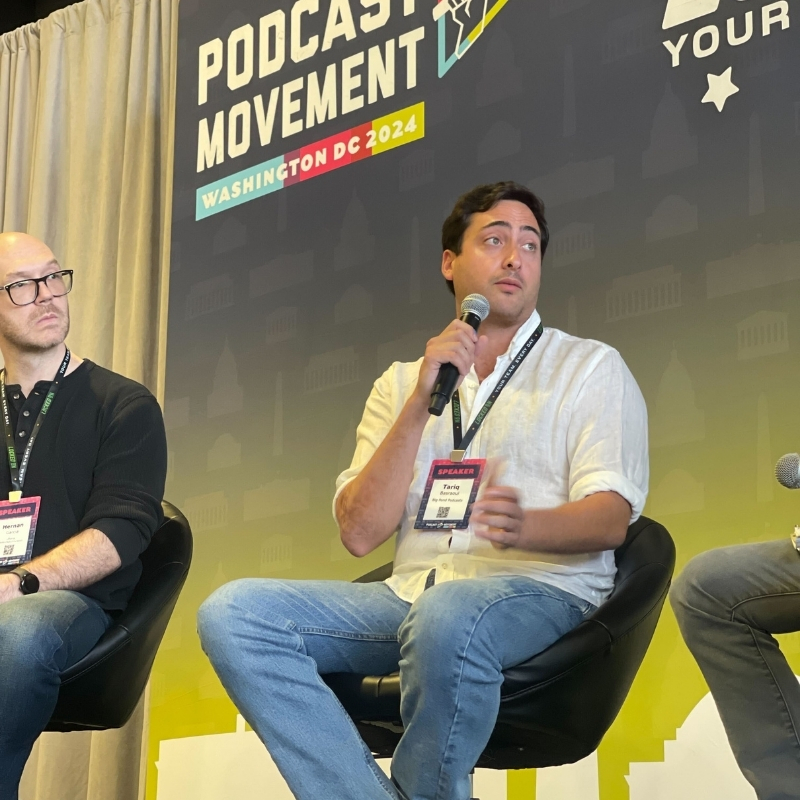
Tariq Basraoui
CEO
Tariq O’Keefe Basraoui, Co-Founder of Big Pond Podcasts, is a seasoned digital marketer and community builder with a track record of success at platforms like TikTok and Zencastr. Known for launching Zencastr’s Creator Network to over 15,000 members in 18 months, his expertise lies in growing user bases and enhancing brand engagement.
His strategic approach to growth and community engagement has established him as a leader in creating some of the fastest-growing media networks in podcasting.