Our Blog
Stop Overpaying for Host-Read Podcast Ads
Mid-roll audio spots command double the price because listener completion reaches 80% once the opening ninety seconds pass.
Are host-read sponsorships really the only ads listeners trust?
Most media plans still treat announcer-read ads as a cheap fallback. The numbers don’t back that up.
Sounds Profitable’s study found 81% of listeners trust host-read ads, against 71% who trust announcer-read spots. That’s a 10-point gap, not a chasm.
A 10-point difference matters, but it’s not the full story some buyers tell themselves. If your budget can’t stretch to a host-read deal on every show, an announcer-read spot still lands with most of the audience.
The real risk isn’t picking the “wrong” format. It’s assuming one format works everywhere and skipping the host-read option where it would pay for itself, like a niche interview show where the host’s voice is the whole reason people tune in.
SiriusXM Media’s own data shows three in four listeners prefer ads voiced by the host, and nine in ten listeners have acted on a podcast ad at some point. That’s a strong case for host-read where budget allows it.
But don’t write off announcer-read as a trust liability. Use it where volume matters more than intimacy, and save host-read dollars for the shows where the host’s credibility is the product.
Mid-roll ad placements justify double the price of pre-roll
A buyer who balks at mid-roll pricing is looking at the wrong number.
Springcast reports mid-roll commands a premium of 70 to 100% over pre-roll. Yes, that’s close to double the rate for the same ad length.
The reason isn’t inventory scarcity. It’s listener behavior. Someone who skips the intro and stays through a mid-roll break has already decided to finish the episode.
Pre-roll catches people before they’ve committed. Some bail in the first ninety seconds, long before your spot even finishes.
So the premium isn’t padding. It’s priced against completion, which is the metric that actually predicts whether anyone heard your message at all.
If your plan leans heavily on pre-roll because it’s cheaper per unit, you may be buying impressions nobody finishes. Shift some spend to mid-roll on shows with strong retention, even at the higher rate, and you’ll likely get more finished listens per dollar, not fewer.
Siloed podcast ad campaigns reduce total purchase intent
Treating podcasts as their own lane is a common planning habit. It’s also leaving reach on the table.
iHeartMedia found that pairing broadcast radio with podcasts opens up 85% of ad-supported audio consumption. The same pairing drove 28% higher purchase intent than podcasts running alone.
That’s not a small lift. It’s the difference between a campaign that nudges awareness and one that moves people toward a purchase decision.
The instinct to silo podcasting makes sense on paper. Separate budget lines, separate reporting, separate teams managing each channel.
But listeners don’t experience media in silos. Someone hears your brand on drive-time radio, then hears it again mid-episode on their commute podcast. AdsWizz’s analysis of industry conversations puts it plainly: podcasting now sits alongside streaming audio and broadcast as part of one strategy, not a standalone channel.
Combine the planning, even if the buying stays separate by necessity.
Do programmatic campaigns require complex third-party audience data?
Buyers assume precision targeting means buying more data. iHeartMedia’s own guidance says the opposite.
Effective programmatic audio targeting comes from first-party signals: what listeners choose, how long they stay, and when they tune in. Not a stack of third-party identifiers bought from a broker.
That’s a simpler system than most planners expect. It’s also a cheaper one, since you’re not paying for data layers on top of media spend.
The trade-off is real, though. First-party behavioral data only works as well as the publisher’s own measurement.
A podcast network with weak listener analytics can’t give you the tune-in timing or content-choice signals that make this targeting work. You end up back where you started, guessing.
If the answer is vague, the targeting will be too.
Dynamic ad insertion drives more revenue than baked-in sponsorships
Producers who still bake ads permanently into an episode file are leaving money on the table, and the revenue data proves it.
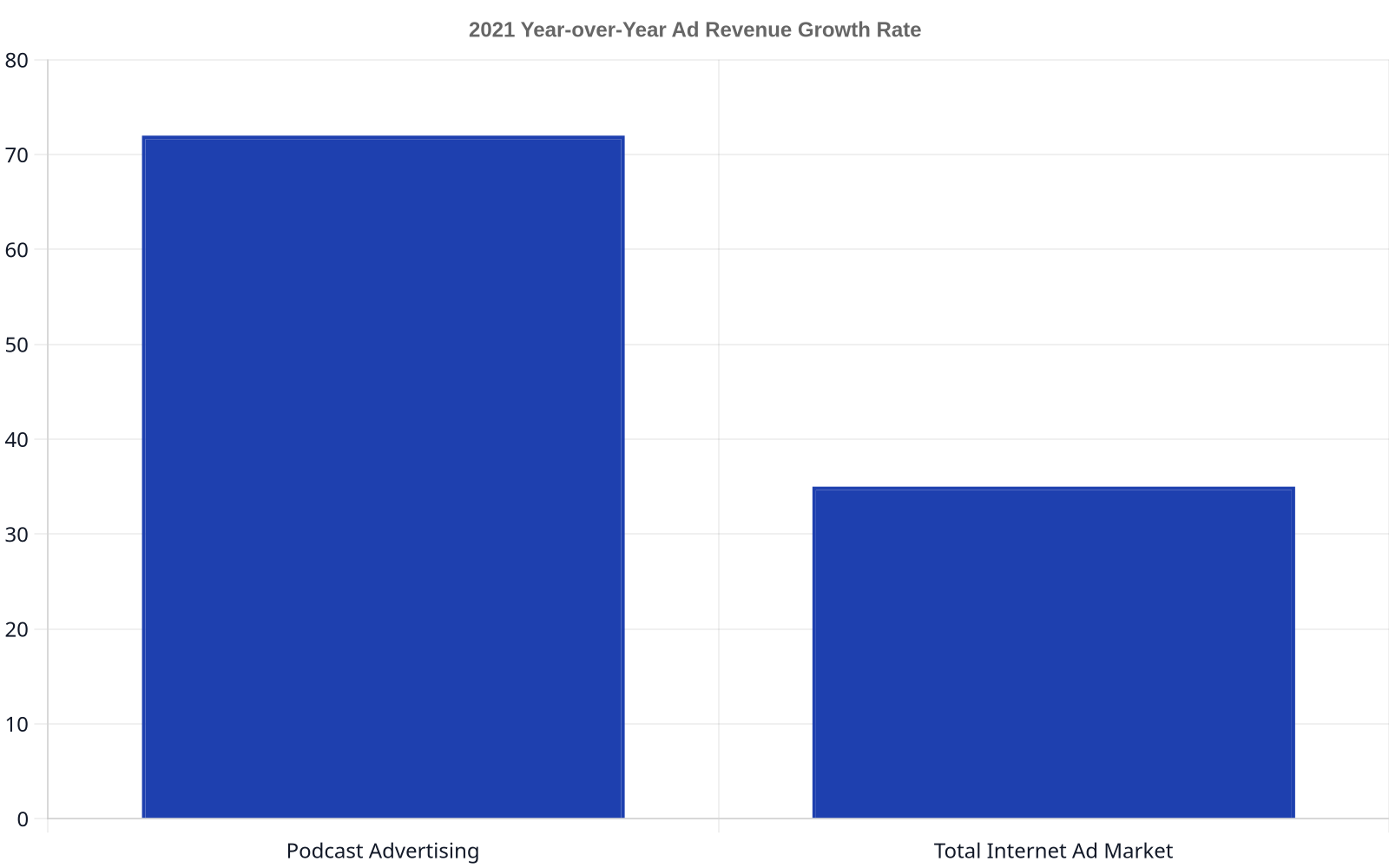
US podcast ad revenue crossed $1 billion for the first time in 2021, according to the IAB and PwC’s podcast ad revenue study. Growth that year ran at 72%, more than double the 35% growth rate of the total internet advertising market.
Dynamic Ad Insertion, or DAI, played a central role in that jump. AdsWizz explains that DAI lets publishers swap ads in and out automatically, without re-encoding the whole episode file every time a sponsor changes.
A baked-in ad is frozen the moment you publish. If the sponsor pulls out, or the campaign ends, that old episode still plays a dead ad to every new listener for years.
DAI fixes that. New campaigns slot into old episodes, which means your back catalog keeps earning instead of sitting there with expired offers nobody can act on.
Why Podcast Advertising Defies Traditional Digital Media Growth
The pattern holds beyond podcasts specifically. Online audio consumption overall has climbed from 5% of Americans listening monthly in 2000 to 79% in 2025, according to Edison Research’s Infinite Dial study.
That’s a quarter-century of near-uninterrupted growth. Most digital ad channels don’t have that kind of curve.
Podcast completion rates back it up at the format level too. iHeartMedia reports 80% average completion rates on podcast episodes, with 67% of consumers saying they’ve explored a brand after hearing it mentioned on a show.
Put the revenue growth next to the completion and recall numbers, and the picture is consistent: people finish episodes, they trust what they hear, and they act on it more than skeptical buyers assume.
Frequently Asked Questions
Is host-read advertising still worth the premium in 2026?
Yes, where the host’s voice carries real authority with the audience. SiriusXM Media’s data shows host reads produce roughly 10 points higher unaided recall than pre-produced or announcer-read ads, which justifies the higher production cost on shows with strong host credibility.
Should every campaign use dynamic ad insertion instead of baked-in ads?
For any show expected to keep earning after launch, yes. Baked-in ads freeze in place and go stale the moment a campaign ends, while DAI lets a network refresh ads in old episodes automatically, which is part of why US podcast ad revenue crossed $1 billion in 2021.
Does podcast advertising work better combined with other channels?
It performs better paired with broadcast radio than run alone, according to iHeartMedia’s data showing 28% higher purchase intent from combined radio-and-podcast campaigns. Treating podcasts as an isolated line item misses that lift.
Is mid-roll always worth the extra cost over pre-roll?
On shows with strong listener retention, yes, because mid-roll spots get heard to completion far more often. On shows with high early drop-off, the premium is harder to justify, so check a show’s completion data before committing the higher rate.
The format fights over host-read versus announcer-read, or pre-roll versus mid-roll, are smaller than they look. The bigger risk sitting in most 2026 media plans is treating podcast inventory as a single, interchangeable thing instead of matching the format to what the data actually shows about that specific show’s audience. Get that match wrong consistently, and you’ll see shrinking completion rates and advertisers who don’t renew, long before anyone updates the media plan to explain why.
If you manage podcast ad inventory and want to see where dynamic ad insertion or cross-channel bundling fits your shows, book a call with our team at Big Pond Podcasts.
About the author
Tariq Basraoui
CEO
Tariq O’Keefe Basraoui, Co-Founder of Big Pond Podcasts, is a seasoned digital marketer and community builder with a track record of success at platforms like TikTok and Zencastr. Known for launching Zencastr’s Creator Network to over 15,000 members in 18 months, his expertise lies in growing user bases and enhancing brand engagement.
His strategic approach to growth and community engagement has established him as a leader in creating some of the fastest-growing media networks in podcasting.