

Promo codes accurately tie a definitive sale to an audio campaign, while vanity URLs reliably measure early audience interest and site traffic. Both methods suffer from severe attribution leakage when listeners change devices, clear their cookies, or bypass your tracking setups entirely.
Choosing the right mechanism decides whether you report the true return on your ad spend or lose valuable sponsor renewals over uncounted conversions. You need concrete tracking frameworks that survive complex, multi-touch listener journeys.
Comparing promo codes and vanity URLs side by side
A vanity URL relies on listeners remembering a short audio cue and typing it directly into their browser. This method records the initial visit through a redirect, but misses people who search your brand or visit directly later. If the listener skips the short link entirely, you lose the tracking completely.
Vanity URLs function purely as an entry mechanism to capture intent before the listener browses other items. They rely entirely on the user taking immediate action while the audio cue remains fresh in their memory.
You must pair these short links with active backend data collection to make them useful. Lock the source field in your CRM, HubSpot, Salesforce, or Pipedrive to prevent later touch overwrites. Look for source field overwrites from downstream conversion touches, and set the field to keep the original value so a later retargeting ad cannot erase the listener’s first visit.
Promo codes attribute revenue right at the point of sale, bypassing the need for a perfect click path.
These codes capture the final transaction, but fail when buyers forget the sequence or rely on browser auto-fill tools. You get undeniable proof of purchase, but you sacrifice visibility into the earlier stages of the listener’s buying cycle. This definitive link makes codes highly favored by direct-response advertisers pushing immediate sales.

Test your vanity URL parameters in real-time analytics before launching any audio placements. Watch your destination URL land in Google Analytics 4 (GA4) Realtime under the correct source and medium to confirm your Urchin Tracking Module (UTM) parameters remain intact.
Resolving untagged redirect targets early prevents your incoming podcast traffic from registering as generic direct visits. Marketers frequently rely on URL shorteners to manage their offline tracking links, but these tools often restrict path-level redirects to their premium tiers. Building your own redirect server removes these limitations but introduces hosting costs, security certificate management, and ongoing technical maintenance.
Relying exclusively on one tracking method leaves massive gaps in your campaign data.
A listener might type your short link on their phone during a commute, but switch to a laptop to complete the purchase without the code. You must implement overlapping systems to capture these fragmented user journeys effectively. Consider how offline channels dictate different tracking requirements based on audience attention spans and device types.
Custom domain forwarding frequently breaks attribution if you fail to configure the redirect path correctly. Forwarding a secondary domain directly to your main site registers the incoming traffic as a self-referral unless you append specific tags.
This distinction matters because executives judge podcast performance strictly against other digital acquisition channels. You cannot ask a chief marketing officer to accept anecdotal evidence when paid social platforms offer precise cost-per-lead calculations. Securing future budgets requires presenting airtight conversion data that rivals your programmatic display channels.
Conversion-Point Tracking: Promo Codes and Checkout Verification
Attribution models break down when real-world listener behavior diverges from your intended tracking path. You might give ten influencers unique promo codes that show 200 redemptions over three months, while your organic installs spike by 2,000 during the same campaigns. Providing another five influencers with tracking links might yield 150 clicks, even though actual installations run three times higher than the links captured.
This massive discrepancy occurs because listeners rarely follow instructions perfectly. They hear your host-read ad, search your brand name on a different device hours later, and completely bypass your tracking infrastructure.
Apply hybrid attribution fallback and priority logic inside your attribution rules engine to close these gaps. Look for the presence or absence of promo code redemptions versus UTM click parameters for each transaction. If a promo code is redeemed but UTMs are missing, attribute the sale directly to the code’s channel.
You can also attribute to the UTM if the code is absent, and treat the conversion as fully corroborated when both elements align.
This layered approach accurately models podcast ad placement best practices for 2026. It catches listeners who heard the read but only fulfilled one half of your tracking requirements. Many direct-response buyers fail to recognize the operational friction involved in maintaining these redundant tracking systems.

Coupon aggregators routinely intercept listeners right at the conversion point. Audit the search engine results pages for branded coupon queries to spot unauthorized affiliate aggregators controlling your search rankings. Deploy a brand-owned official promo code savings page that directs shoppers directly to checkout to bypass competitors entirely.
These third-party affiliates manipulate search results to capture users who are already determined to buy. They host broken codes or introduce competing merchants into your buyer’s consideration set.
You must account for how listeners actually interact with modern checkout flows.
Native browser extensions automatically test dozens of codes during checkout, often overwriting your specific creator’s discount. This strips the revenue credit away from your podcast placement and hands it to a software tool. Affiliate marketing accounts for an estimated 16 percent of ecommerce sales globally, meaning a massive portion of online revenue filters through third-party tracking.
Address this by strictly limiting affiliate program payouts for podcast-specific promotional phrases. Block auto-fill extensions from applying creator codes to ensure your niche podcast advertising opportunities in 2026 retain their proven ROI.
Single-source attribution methodology helps you measure which channels actually generate net-new demand. It focuses entirely on the entry point rather than distributing fractional credit across multiple downstream interactions. This lets you calculate an accurate cost-per-lead by channel and identify which audio properties deliver the highest-quality buyers.
Frequently Asked Questions
How do agencies track a client’s vanity URL in Google Analytics?
Agencies append standard UTM parameters to the hidden redirect destination instead of tagging the short vanity URL itself. When a listener visits the memorable link, the server forwards them to a full address containing the source and medium data. Google Analytics captures these parameters upon arrival to credit the audio campaign.
Confirm the vanity URL and destination page in writing before configuring any redirects. Point the vanity URL’s server redirect at the full tagged destination rather than the bare landing page.
How does Castlytics attribute conversions without IP matching?
You register creator placements inside the Castlytics campaign configuration dashboard using paired vanity paths and promo codes. Enter the creator name, channel, vanity path, and promo code to generate the corresponding tracking link automatically.
This self-serve model gives independent advertisers full control over their audio measurement strategy. You bypass the restrictive walled gardens that limit data access to specific proprietary ad networks. The resulting dashboard provides transparent metrics that prove your campaign’s precise value.
How to protect my programme against unauthorised voucher codes?
Monitor external search engine results for your brand name combined with discount keywords. Identify broken codes or third-party sites hijacking your podcast host endorsement deals and intercepting your listeners. Hosting an official savings page on your own domain prevents these aggregators from stealing your hard-earned attribution.
You must actively identify high-performing partners to maximize your overall return on investment. Unchecked voucher leakage drains your budget by paying commissions to affiliates who generated zero initial demand. Early detection of this unauthorized activity ensures your marketing investments generate authentic, verifiable results.
Could a small field in your checkout be sending revenue to coupon affiliates?
A prominent promo code box actively encourages ready buyers to leave your checkout page to search for discounts. Affiliate sites capture these users, inject their own tracking cookies, and claim the final commission. This mechanism overwrites your original source data and inflates your perceived acquisition costs.
You fix this leakage by designing tight checkout experiences that keep the buyer focused on completion. Hide the promotional field behind a subtle text link rather than displaying a massive empty text box. This minimal design adjustment drastically reduces cart abandonment while preserving your podcast attribution.
Why not put the final URL directly in the QR code?
Long destination URLs containing tracking parameters create dense QR codes that smartphone cameras struggle to read from a distance. Using a short vanity URL as the QR code’s target creates a much simpler visual pattern. You also preserve the ability to update the final destination link without having to reprint physical marketing materials.
The physical properties of printed tracking materials demand optimized visual elements. A complex matrix forces users to approach the code physically, which severely limits engagement at event booths or transit stops. Shortening the underlying data makes the code readable from a much wider variety of camera angles and distances.
About the author
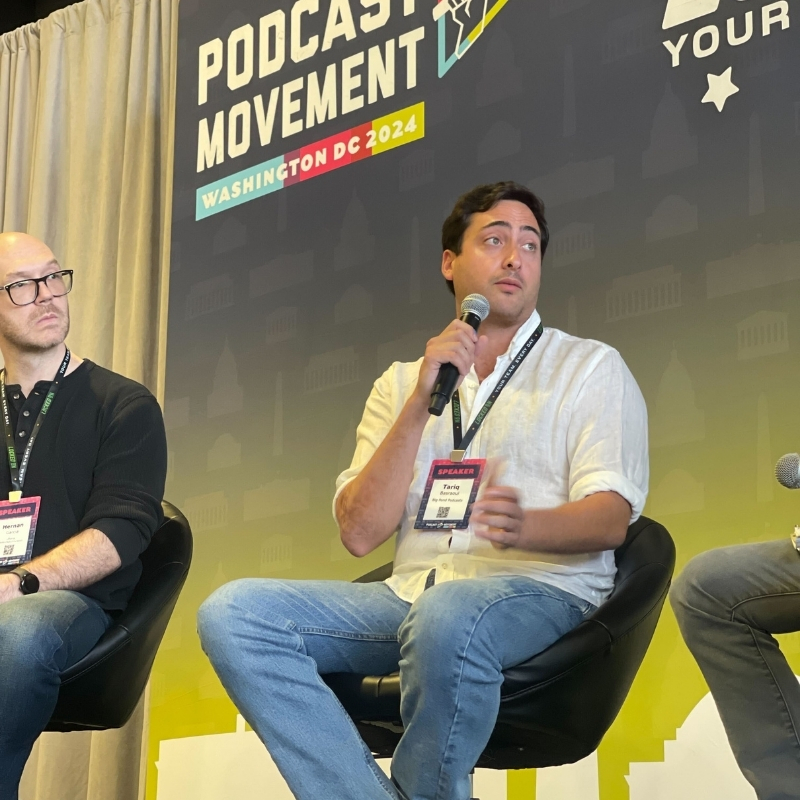
Tariq Basraoui
CEO
Tariq O’Keefe Basraoui, Co-Founder of Big Pond Podcasts, is a seasoned digital marketer and community builder with a track record of success at platforms like TikTok and Zencastr. Known for launching Zencastr’s Creator Network to over 15,000 members in 18 months, his expertise lies in growing user bases and enhancing brand engagement.
His strategic approach to growth and community engagement has established him as a leader in creating some of the fastest-growing media networks in podcasting.
