

A podcast network will typically take between 15% and 50% of your advertising revenue. The exact percentage depends on the services provided, your show’s audience size, and your contract terms. For shows with smaller but growing audiences, the split often lands in the 30-50% range, while established podcasts with large download numbers can negotiate closer to a 15-20% share. This revenue share is the primary cost of joining a network, exchanged for access to advertisers and growth support.

Podcast networks exist to create value for both creators and advertisers. For creators, they offer monetization and audience growth. For advertisers, they offer access to engaged audiences. The cost is a share of the revenue generated. Here is a breakdown of what a network might take based on the services they offer.
| Service Offered | What It Generally Includes |
|---|---|
| Ad Sales Representation | A sales team that finds and manages sponsors, negotiates ad rates (CPMs), and handles invoicing. |
| Full Production & Editing | Includes ad sales plus audio engineering, show note writing, transcript creation, and episode uploading. |
| Marketing & Cross-Promotion | Placement in network-wide promotional spots, social media marketing, and features in newsletters. |
| Content & Growth Strategy | Strategic guidance on content, audience development, and brand building. |
How Podcast Networks Make Money: Understanding Revenue Streams

The primary way podcast networks generate income is by selling advertising inventory across their roster of shows. They aggregate audiences to attract larger brands that individual podcasters might not be able to secure. This is typically done by selling ad slots on a Cost Per Mille (CPM) basis, which is the price an advertiser pays for one thousand downloads of an episode containing their ad. For context, our network sees an $22.35 (as of October 2026)Avg. 60-Sec CPM, which provides a benchmark for what quality inventory can command.
Networks then take a percentage of that ad revenue. For example, if your podcast generates $1,000 (as of October 2026)in ad revenue and your network agreement is a 70/30 split, you would receive $700 and the network would keep $300. This fee covers their operational costs, including sales staff, technology, and marketing efforts to promote the network’s shows.
Some networks, especially those that function as a podcast agency or incubator, may also have other revenue streams. These can include charging for premium production services, consulting on show growth, or creating branded content series in partnership with large companies. This is part of why we built Big Pond Podcasts as an incubator for shows, providing the tools and network to monetize your show effectively.
How Podcast Networks Impact Your Earnings
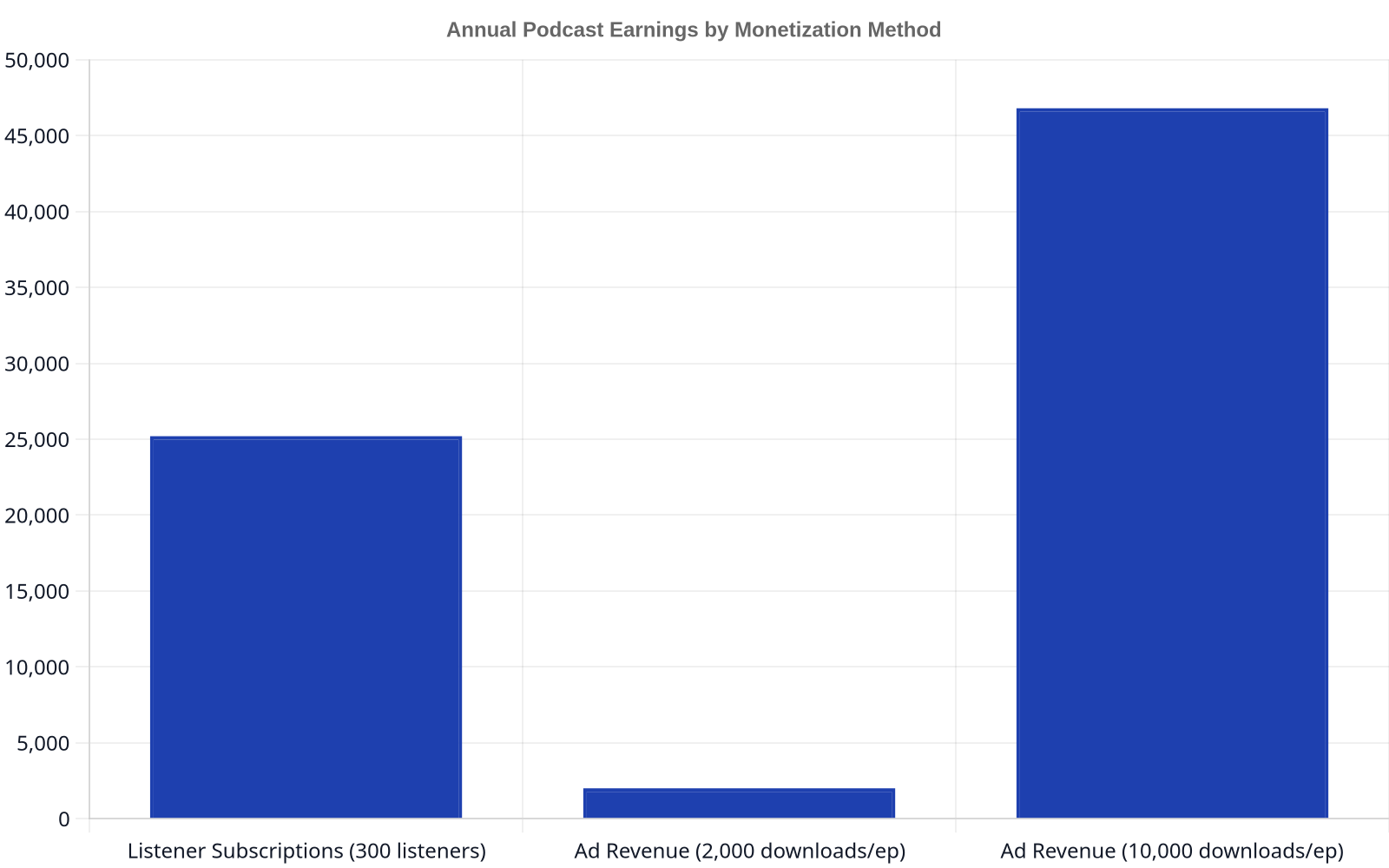
Joining a network can significantly change your income potential, both positively and negatively. An established network brings access to major advertisers like American Express or Walmart, opportunities you might not find independently. A show with 10,000 downloads per episode running three ad slots at a $30 (as of October 2026)CPM earns $900 per episode. With a network securing those deals, even after a 30% cut, you earn $630 per episode, or over $32,000 a year for a weekly show, from deals you likely wouldn’t have had otherwise.
However, it’s crucial to understand the requirements. Most reputable networks require a minimum number of downloads per episode, often starting at 5,000 or 10,000, and a consistent publishing schedule. It’s a sobering fact that only 7.1% of podcasts get 5,000 downloads per episode, and just 2% reach 20,000 downloads. This data highlights the selectivity of top-tier networks.
The value of a network isn’t just the check they send. It’s the deals you couldn’t get, the audience you couldn’t reach, and the time you get back by not having to sell.
Before signing, always scrutinize the contract terms. Pay close attention to exclusivity clauses, which may prevent you from running your own ads or joining other platforms. Also, understand the contract duration and termination clauses, as some agreements can be difficult to exit if the partnership isn’t delivering results. Negotiating a trial period or performance-based exit clauses can provide a valuable safety net. For a deeper look at specific deal structures, you can explore our guide on podcast endorsement deals.

Factors Influencing a Network’s Cut

The percentage a podcast network takes is not arbitrary. It’s a calculated figure based on several key factors. Understanding these variables gives you a stronger position when negotiating a contract.
Your Audience Size and Engagement
The single biggest factor is your download numbers. A podcast with 100,000 downloads per episode has far more negotiating power than one with 10,000. Networks are competing for top-tier inventory, and they will offer more favorable splits to secure popular shows. Engagement metrics, such as listener retention and social media following, also play a role in demonstrating the value of your audience.
Your Podcast’s Niche
A highly specific, sought-after niche can command better terms, even with a smaller audience. If your podcast reaches an affluent or hard-to-target demographic (e.g., CFOs, surgeons, enterprise software developers), advertisers will pay a premium. This makes your show more valuable to a network, giving you use to ask for a larger revenue share. These opportunities can be more valuable than you think; you can learn more about niche podcast advertising.
Scope of Services Provided
A network that only sells ads will take a smaller cut than a full-service network that also handles production, editing, marketing, and distribution. If you are outsourcing your entire podcasting operation, expect to give up a larger percentage of the revenue. Conversely, if you only need a sales team, you can argue for a split closer to the 20-30% range.
Exclusivity and Term Length
Exclusivity is a major bargaining chip. An exclusive agreement, where the network is your sole representative for ad sales, is more valuable to them and should result in a better revenue split for you. Similarly, a longer contract term (e.g., two years vs. one year) reduces the network’s risk and may persuade them to offer more favorable terms upfront.

Further reading
- Q&A with Will Pearson ’01, COO, iHeart Podcast Network – Duke Arts
- Roseman University Podcast Network
FAQ
What is a typical revenue split with a podcast network?
A typical revenue split is between 70/30 and 50/50 in the creator’s favor. A 70/30 split (70% to the podcaster, 30% to the network) is common for ad representation alone. If the network provides additional services like production and marketing, the split may move closer to 60/40 or 50/50.
Do I have to pay to join a podcast network?
No, you should not have to pay an upfront fee to join a legitimate podcast network. Their business model is based on taking a percentage of the revenue they help you generate. Any network asking for a large upfront payment for “membership” should be viewed with caution.
How many downloads do I need to join a podcast network?
Most reputable networks require a minimum of 5,000 to 10,000 downloads per episode within the first 30 days of release. Some top-tier networks may require 50,000 or more. These numbers ensure your show has a large enough audience to be attractive to advertisers.
Can I negotiate my revenue share with a podcast network?
Yes, revenue shares are often negotiable. Factors like your download numbers, audience demographics, the exclusivity of your contract, and the length of the term can all be used as use to negotiate a more favorable split. Having competing offers from other networks also strengthens your position.
What are the main benefits of joining a podcast network?
The primary benefits are access to a professional ad sales team, higher CPMs from larger advertisers, and cross-promotional opportunities with other shows in the network. This can lead to significant revenue and audience growth that is difficult to achieve independently.
Are there drawbacks to joining a podcast network?
The main drawbacks are sharing your revenue, potentially losing some creative control over ad placements, and being locked into a contract. It’s essential to weigh these cons against the potential benefits before signing an agreement.
Joining a network is a significant step that can accelerate your podcast’s growth and profitability. By understanding the costs, contract terms, and negotiation points, you can make a decision that aligns with your long-term goals. If you’re ready to explore how a network can help you grow, we can help you find the right path.
About the author
Tariq Basraoui
CEO
Tariq O’Keefe Basraoui, Co-Founder of Big Pond Podcasts, is a seasoned digital marketer and community builder with a track record of success at platforms like TikTok and Zencastr. Known for launching Zencastr’s Creator Network to over 15,000 members in 18 months, his expertise lies in growing user bases and enhancing brand engagement.
His strategic approach to growth and community engagement has established him as a leader in creating some of the fastest-growing media networks in podcasting.
