

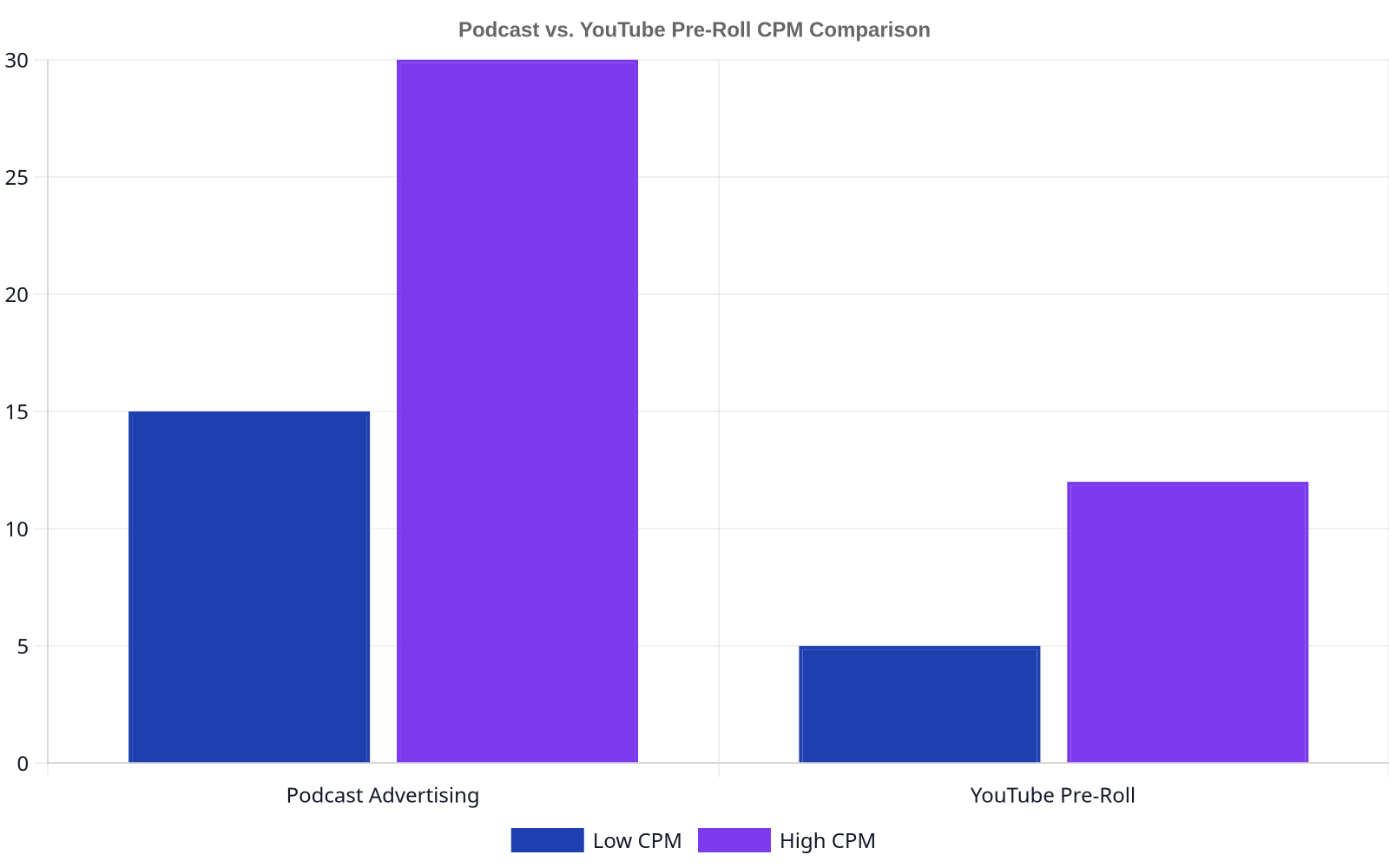
Podcast advertising typically costs between $15 (as of October 2026)to $30 CPM, while YouTube pre-roll ads cost $0.01–$0.05 per view or $5–$12 CPM. The podcast advertising vs YouTube pre-roll cost comparison reveals a key difference in strategy. Podcasts offer deep engagement and host-trusted endorsements perfect for brand building with niche audiences. YouTube provides massive reach and granular visual targeting ideal for broad awareness and direct response campaigns driven by visual calls to action. Your choice depends entirely on your campaign goals, budget, and target audience’s media habits.
Which to Pick in 60 Seconds
- Choose Podcast Ads if: Your goal is brand affinity and trust. You want to reach a highly engaged, niche audience that trusts host recommendations. Your product or service benefits from storytelling and doesn’t require a visual demonstration.
- Choose YouTube Pre-Roll if: Your goal is broad reach and direct response. You need precise demographic targeting and have a visually compelling product. Your campaign relies on clicks and immediate conversions.
Understanding Podcast Advertising Costs & Formats
Podcast advertising connects brands with listeners through audio ads placed within episodes. The power of this format lies in the intimate relationship between a host and their audience. This trust translates directly to ad effectiveness.
Podcast Ad Placements: Pre-Roll, Mid-Roll, Post-Roll
Ad placement dramatically affects both cost and listener reception. At Big Pond Podcasts, we help creators implement various formats. The three primary placements are pre-roll, mid-roll, and post-roll.
Pre-roll ads are 15-30 second spots that play at the beginning of an episode. They typically have a CPM of $15 to $25. This placement ensures most listeners hear the ad, but it occurs before the host has built momentum.
Mid-roll ads, usually 60 seconds, are the most valuable and effective placement. They run during a break in the episode content, commanding the highest CPMs of $15 to $30. Listeners are already engaged, making them more receptive to the message.
Post-roll ads play at the end of the episode and are the least expensive, often with CPMs from $5 to $10. Their lower cost reflects the reality that many listeners drop off before an episode fully concludes.
Podcast Ad Types: Host-Read vs. Pre-Produced
The delivery of the ad is just as important as its placement. The two main types are host-read ads and pre-produced spots. We find that host-read ads generate a powerful, authentic connection that pre-produced ads struggle to match.
A host-read ad is a personal endorsement from the host in their own voice. This format feels less like a traditional advertisement and more like a genuine recommendation. It is the gold standard for building brand trust with a podcast’s audience.
Pre-produced ads are created by the advertiser and inserted into the podcast, similar to a traditional radio commercial. They offer consistency across multiple shows but lack the personal touch that makes podcast advertising unique.
The real value isn’t just in the number of downloads; it’s in the dedicated attention a listener gives to a trusted host for 30-45 minutes at a time.
How Podcast Ads are Priced (CPM)
Podcast advertising is primarily sold on a Cost Per Mille (CPM) basis, meaning the advertiser pays a flat rate for every 1,000 downloads an episode receives. This pricing model provides predictable costs based on a show’s reach. For a deeper look at this model, you can review details on podcast advertising CPM.
Factors that influence CPM include audience size, listener demographics, and the content niche. A podcast about financial software for enterprise clients will command a much higher CPM than a general pop culture show due to the audience’s value.
Deconstructing YouTube Pre-Roll Ad Costs & Formats
YouTube advertising operates within the Google Ads ecosystem, offering immense scale and sophisticated targeting. Pre-roll ads are the video commercials that run before a user’s selected video begins. They are a fundamentally visual and interactive format.
YouTube Ad Formats: Skippable, Non-Skippable, and Bumper Ads
YouTube offers several pre-roll formats, each with different pricing models and use cases.
Skippable in-stream ads are the most common format. These ads can be skipped after 5 seconds, and advertisers typically only pay when a user watches at least 30 seconds (or the full ad if shorter) or interacts with it. This pay-for-performance model is highly efficient.
Non-skippable in-stream ads are 15-20 seconds long and must be watched in their entirety. They are sold on a CPM basis and guarantee the message is seen, but they can also be more intrusive to the user experience.
Bumper ads are 6-second, non-skippable ads sold on a CPM basis. They are designed for quick, memorable brand messages to supplement a larger campaign.
How YouTube Ads are Priced (CPV, CPM, CPC)
Unlike the straightforward CPM of podcasts, YouTube uses a dynamic auction system with multiple pricing models. Your cost is determined by your bid, targeting, and the level of competition.
Cost Per View (CPV) is the most common model for skippable ads, with typical costs ranging from $0.01 to $0.05 per view. You only pay for engaged viewers, making it a cost-effective choice. A recent expert guide breaks down these auction dynamics in detail.
Cost Per Mille (CPM) is used for non-skippable and bumper ads, where you pay per 1,000 impressions. These rates often fall between $5 and $12. This is ideal for campaigns focused on maximizing reach and awareness.
Cost Per Click (CPC) is relevant for ad formats designed to drive traffic, like in-feed ads. Here, you pay when someone clicks your ad, with costs often between $0.50 and $3.50, depending on the industry and keyword competition.
Key Differences: Podcast Ads vs. YouTube Pre-Roll
| Attribute | Podcast Advertising | YouTube Pre-Roll Ads | |
|---|---|---|---|
| Format | Audio-based, often conversational | Video-based, visual and audio | |
| Audience Engagement | Highly engaged, intimate listening experience | Often skippable, visual impact | |
| Ad Placement | Within podcast episodes | Before YouTube videos | |
| Targeting Capabilities | Podcast genre, audience demographics, host-read | Demographics, interests, video content, keywords, custom audiences | |
| Cost Models | CPM (Cost Per Mille), CPA (Cost Per Acquisition) | CPV (Cost Per View), CPM (Cost Per Mille) | |
| Measurement | Downloads, listens, promo codes, brand lift | Views, clicks, conversions, brand lift surveys | |
| Creative Control | Often host-read, more flexible | Requires polished video assets, strict guidelines |
The podcast advertising vs YouTube pre-roll cost comparison goes beyond simple CPM rates. The core differences lie in audience mindset, targeting capabilities, and the nature of creative execution. Understanding these nuances is critical for allocating your budget effectively.
Audience Intent and the Attention Economy
A key difference is the user’s mindset. Podcast listeners are in an audio-first, lean-back mode of consumption. They are often engaged in another activity like commuting or exercising, offering a unique opportunity for brands to connect during screen-free moments. The average podcast listener is also highly dedicated; research from Edison Research shows that super listeners consume over 11 hours of podcasts per week.
YouTube viewers, in contrast, are in a lean-forward, visual mode. They are there to watch something specific, and your ad is an interruption. This means you have about five seconds to capture their attention before they hit ‘Skip Ad’.
An ad on YouTube is a visual interruption you must overcome, while an ad on a podcast is often a personal conversation you are invited into.
Targeting Capabilities
YouTube’s connection to the Google Ads platform provides unparalleled targeting precision. You can target users based on demographics, search history, online behavior, location, interests, and specific videos or channels they watch. For brands needing to reach a very specific customer profile, this is a major advantage.
Podcast advertising targeting is broader but powerful in its own context. Targeting is primarily based on the podcast’s topic and audience psychographics. By choosing a show like Business of Tech, you are inherently reaching an audience interested in IT services. This context-based approach ensures relevance and can lead to niche podcast advertising with highly motivated listeners.
Measuring Performance and Attribution
YouTube offers strong, immediate analytics through the Google Ads dashboard. You can track views, clicks, conversions, view-through rates, and dozens of other metrics in real-time. This makes it straightforward to calculate direct ROI.
Podcast ad attribution has traditionally been more challenging, relying on vanity URLs, promo codes, and post-purchase surveys. However, the industry is advancing with pixel-based attribution and other technologies. While not as granular as YouTube, the impact is often seen in brand lift and long-term customer value, which our podcast advertising case studies demonstrate.

The Verdict: Choose Podcast Ads If…
- Your primary goal is brand trust and affinity. Host-read ads are recommendations from a trusted source, and Nielsen data shows they build strong brand recall and purchase intent.
- You want to reach a specific, dedicated niche. Podcast topics serve as a powerful proxy for audience interest, allowing you to connect with passionate communities.
- Your product or service benefits from storytelling. Complex services, B2B solutions, or brands with a strong mission can use the longer format to explain their value proposition effectively.
- Your budget allows for a campaign-level investment. Meaningful results often require a minimum spend of around $5,000 (as of October 2026)to achieve the frequency needed for impact.
The Verdict: Choose YouTube Pre-Roll If…
- Your primary goal is direct response and lead generation. The clickable, visual format is built to drive immediate action, sending users to a landing page or product site.
- You need to reach a massive, broad audience. YouTube’s user base of over two billion people offers scale that podcasts cannot match.
- Your product is highly visual. A visually appealing product, a software demo, or an engaging video creative will perform significantly better on YouTube.
- You have a smaller, experimental budget. You can start a YouTube campaign with a very small daily budget to test creatives, targeting, and messaging before scaling up.
Ultimately, the question of whether you should invest in podcast advertising vs. YouTube pre-roll ads isn’t always an either/or decision. Many successful brands use both platforms to achieve different marketing objectives. A podcast campaign can build brand love and trust, while a YouTube retargeting campaign can capture that interest and drive a conversion.
FAQ
What is a good minimum budget for podcast advertising?
While you can buy ads on smaller shows for a few hundred dollars, a meaningful campaign with measurable impact typically requires a minimum budget of $5,000. This allows you to advertise on a few relevant shows or achieve enough frequency on one larger show to influence listener behavior.
What is a good minimum budget for YouTube ads?
You can technically start a YouTube ads campaign with as little as $10 a day. This is useful for testing, but a budget of at least $1,000 to $2,000 per month is recommended to gather enough data to optimize for performance and see tangible results.
Which is better for direct response, podcasts or YouTube?
YouTube is generally better for direct response because of its visual, clickable format and precise targeting that can drive immediate action. However, podcast ads can be highly effective for direct response with strong calls to action, vanity URLs, and promo codes, especially for high-consideration products.
How is ROI measured for podcast ads?
ROI for podcast ads is measured through a combination of methods. Direct attribution uses unique promo codes and vanity URLs. Brand lift studies measure changes in audience awareness and perception before and after a campaign. For many advertisers, the long-term value of acquiring a customer through a trusted channel is the ultimate measure of success.
Can I use the same ad creative for podcasts and YouTube?
No, you should not use the same creative. Podcast ads are audio-first and rely on storytelling and vocal tone. YouTube ads are visual-first and must capture attention without sound in the first few seconds. Each platform requires a distinct creative strategy tailored to its audience’s consumption habits.
Deciding between these powerful platforms requires a clear understanding of your goals. Whether you need the deep trust of podcasting or the massive scale of YouTube, a well-defined strategy is the key to success. If you’re ready to explore how podcast advertising can fit into your marketing mix, let’s discuss your project.
About the author
Tariq Basraoui
CEO
Tariq O’Keefe Basraoui, Co-Founder of Big Pond Podcasts, is a seasoned digital marketer and community builder with a track record of success at platforms like TikTok and Zencastr. Known for launching Zencastr’s Creator Network to over 15,000 members in 18 months, his expertise lies in growing user bases and enhancing brand engagement.
His strategic approach to growth and community engagement has established him as a leader in creating some of the fastest-growing media networks in podcasting.
