

How to Buy Podcast Ad Slots: A 2026 Buyer’s Guide
Throwing money at podcast advertising without a strategy is just expensive noise. To effectively buy podcast ad slots, focus on audience alignment over raw download numbers. Prioritize host-read endorsements for trust, verify listener demographics with up-to-date media kits, and start with small, measurable test campaigns before scaling. A successful buy is not about reaching the most ears; it’s about reaching the right ears with a message they’ll actually trust, which is a core part of our mission to connect brands with influential hosts.

1. Audience Demographics and Psychographics
This is the most important factor, and it’s not close. Buying an ad on a top-charting podcast is a complete waste if its listeners have no need for your product. You need to go beyond surface-level categories like “Comedy” or “Business.”
First, demand a media kit from any podcast you consider. A professional show will have one. This document should detail listener demographics: age, gender, location, income, and education levels. A 2024provides a great baseline for overall podcast listener demographics, but you need show-specific data.
Next, dig into psychographics, the “why” behind the audience. Are they aspiration-driven? Are they hobbyists? Listen to a few episodes. The host’s language, the guest profiles, and the topics covered will tell you more about the audience’s mindset than a demographic chart ever could.
2. Ad Format and Placement
The type of ad you choose directly impacts its reception and cost. There are three primary placements: pre-roll (before the show), mid-roll (during a content break), and post-roll (after the show). Mid-roll ads tend to perform best because listeners are already engaged.
Then there’s the format. Host-read ads, where the host promotes your product in their own words, are the gold standard for podcast advertising. They feel like a personal recommendation, which is why they often generate the highest conversion rates. We focus on securing these types of authentic sponsorships for brands. The alternative is a programmatic ad, which is often produced by the brand and dynamically inserted into the show. These are less personal but can be effective for broad awareness campaigns.
3. Host Credibility and Endorsement
When a host reads your ad, their personal credibility is on the line. Listeners have a strong bond with their favorite hosts, and that trust transfers to the products they endorse. Before you buy podcast ad slots, vet the host.
Does their public persona align with your brand values? Do they promote a dozen different products every episode, or are they selective? Scarcity is a good sign. A host who only partners with a few brands they genuinely believe in will deliver a much more powerful and convincing endorsement. This is a crucial element for campaigns looking for authentic podcast host endorsements.
A host isn’t just a media channel; they are your brand’s most convincing salesperson. The trust they have with their audience is the single most valuable asset you are buying.
4. Download and Listener Metrics (The Right Way)
Vanity metrics can be misleading. A show with one million downloads per episode sounds impressive, but it means nothing if the listeners aren’t engaged. Look for IAB-certified download numbers. The Interactive Advertising Bureau (IAB) provides technical guidelines that ensure download numbers are a fair representation of actual listeners, not just server bots.
Go deeper by asking for the listener retention rate. How many people who start an episode finish it? A high drop-off rate, especially before the mid-roll ad slots, is a major red flag. Platforms like ours connect advertisers to a network of over 1,300 vetted shows where these metrics are transparent.
5. Cost and Return on Ad Spend (ROAS)
This is the criterion buyers often get wrong. They look for the cheapest ad slot, not the best value. Podcast ads are typically priced on a Cost Per Mille (CPM) basis, meaning the cost per one thousand downloads. While our network sees an average 60-second CPM of around $22.35, this can vary wildly based on the show’s niche, host influence, and ad placement.
Don’t let a high CPM scare you. A $50 CPM on a niche podcast that reaches your exact ideal customer profile is a better deal than a $10 CPM on a general-interest show with a broad, unfocused audience. Track your return by using unique coupon codes, vanity URLs, or post-checkout surveys (“How did you hear about us?”).

Questions to Ask Before You Commit
Use this checklist when talking to podcast reps or ad networks. Their ability to answer these questions clearly is a good indicator of their professionalism.
- Can you provide a recent media kit with IAB-certified download numbers?
- What are your listener demographics (age, gender, location)?
- What are your average episode completion rates?
- Do you offer host-read ads, and can I approve the script or talking points?
- What other brands have advertised on your show in the past six months?
- How much lead time do you need to get a campaign live?
- What kind of performance reporting do you provide?
- Can you share any case studies or results from previous advertisers? Explore some examples in our podcast advertising case studies.
- What is your policy on ad exclusivity for my category?
Red Flags to Watch Out For
- No Media Kit: If they can’t provide basic data on their audience, walk away.
- Vague Metrics: Terms like “potential reach” or “subscribers” are meaningless. Demand IAB-compliant download figures.
- Heavily Discounted Rates: While a good deal is nice, massive, unsolicited discounts might signal that the show is struggling to sell inventory for a reason.
- Conflicting Brand Alignments: If a host promotes your competitor one week and you the next, your message will be diluted.
- Poor Communication: If they are slow or unprofessional during the sales process, imagine the service you’ll get once they have your money.
Your Decision Framework
There is no single “best” podcast. The right choice depends on your campaign goals. Use this simple framework to guide your decision when you buy podcast ad slots.
- If your priority is direct sales and conversion: Weight Host Credibility (#3) and Audience Demographics (#1) highest. A trusted host in a tight niche is your best bet.
- If your priority is brand awareness: Weight Download Metrics (#4) more heavily, but still within a relevant category. The goal is broad, but not untargeted, reach.
- If you are on a tight budget: Focus on Audience Demographics (#1) in smaller, emerging podcasts. You can often find incredible value and a highly engaged audience before a show hits the mainstream and its CPM skyrockets.
FAQ
How much does it cost to buy a podcast ad slot?
Costs vary significantly based on audience size, engagement, and niche. Your total cost will depend on the show’s CPM and the number of listeners per episode.
What is a good CPM for podcast advertising?
A “good” CPM is one that delivers a positive return on ad spend (ROAS) for your business. A higher CPM on a niche show that converts well is better than a low CPM on a broad show that doesn’t.
How are podcast ad listeners measured?
Legitimate podcast downloads are measured using standards set by the Interactive Advertising Bureau (IAB). These guidelines ensure that a “download” represents a real user request and filters out bots or partial requests. Always ask for IAB-certified numbers when you buy podcast ad slots.
Are pre-roll or mid-roll ads more effective?
Mid-roll ads generally show higher engagement and recall rates. Listeners are already invested in the content by the time a mid-roll ad plays. However, pre-roll ads can be effective for strong, concise brand messaging, as every listener will hear the beginning of the episode.
How do I track the success of my podcast ad campaign?
Track success by using campaign-specific tools. The most common methods are creating a unique coupon code for the podcast (e.g., “PODCAST15”), a custom vanity URL (e.g., yourbrand.com/podcast), or asking customers “How did you hear about us?” in a post-purchase survey. This direct attribution is key to calculating ROAS.
About the author
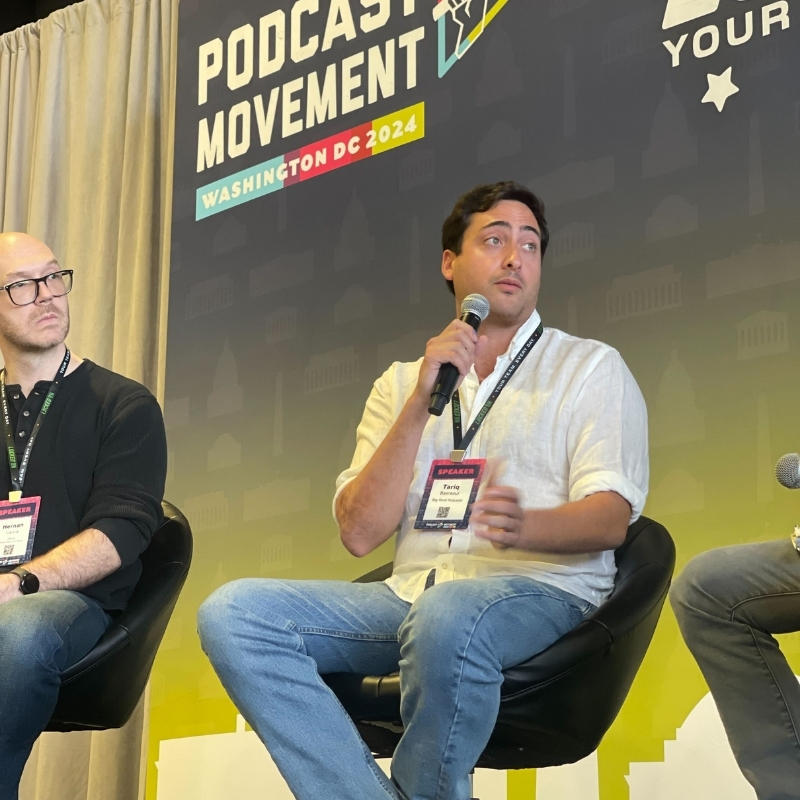
Tariq Basraoui
CEO
Tariq O’Keefe Basraoui, Co-Founder of Big Pond Podcasts, is a seasoned digital marketer and community builder with a track record of success at platforms like TikTok and Zencastr. Known for launching Zencastr’s Creator Network to over 15,000 members in 18 months, his expertise lies in growing user bases and enhancing brand engagement.
His strategic approach to growth and community engagement has established him as a leader in creating some of the fastest-growing media networks in podcasting.
