

A viewer watching a tech interview on YouTube often hears the same sponsor pitch they heard on Apple Podcasts earlier that morning. So, does a video podcast ad reach the same person twice? Yes, video podcast ads frequently reach the same viewer multiple times depending on whether the campaigns run as baked-in files, programmatically inserted media, or native YouTube placements versus open RSS feeds. Advertisers actively manage frequency caps across different ad servers to avoid unwanted duplicate impressions.

The Mechanics of Duplicate Reach in Video Podcasting
A central challenge in digital audio and video buying involves tracking unique viewers across highly fragmented media ecosystems. Media buyers purchasing inventory across 1,300+ podcasts consistently discover that their campaigns hit identical listeners across multiple viewing environments. A user downloading a show on an Apple TV application and later streaming the audio version on an iPhone generates two completely separate ad server requests.
Tracking audience reach overlap requires matching IP addresses and device identification markers to unify these disparate network events. The Interactive Advertising Bureau (IAB) provides specific measurement guidelines for deduplicating these downloads, but true cross-device resolution relies heavily on the specific tracking pixels implemented by the podcast hosting platform. Disconnected reporting structures mean that an impression logged by a traditional RSS feed rarely speaks to the tracking systems utilized by social media video players.
We observe this exact tracking dynamic across the 200M+ monthly listeners reach within our own publisher network. Brands collaborating with us, including BetterHelp, Factor, New Era, and Laird, rely on strict frequency configurations to ensure their messaging remains effective without exhausting the addressable audience. Understanding these technical delivery mechanics remains mandatory for any buyer attempting to calculate accurate return on ad spend (ROAS) across fragmented video placements.
How Dynamic Ad Insertion Tracks and Caps Viewer Frequency
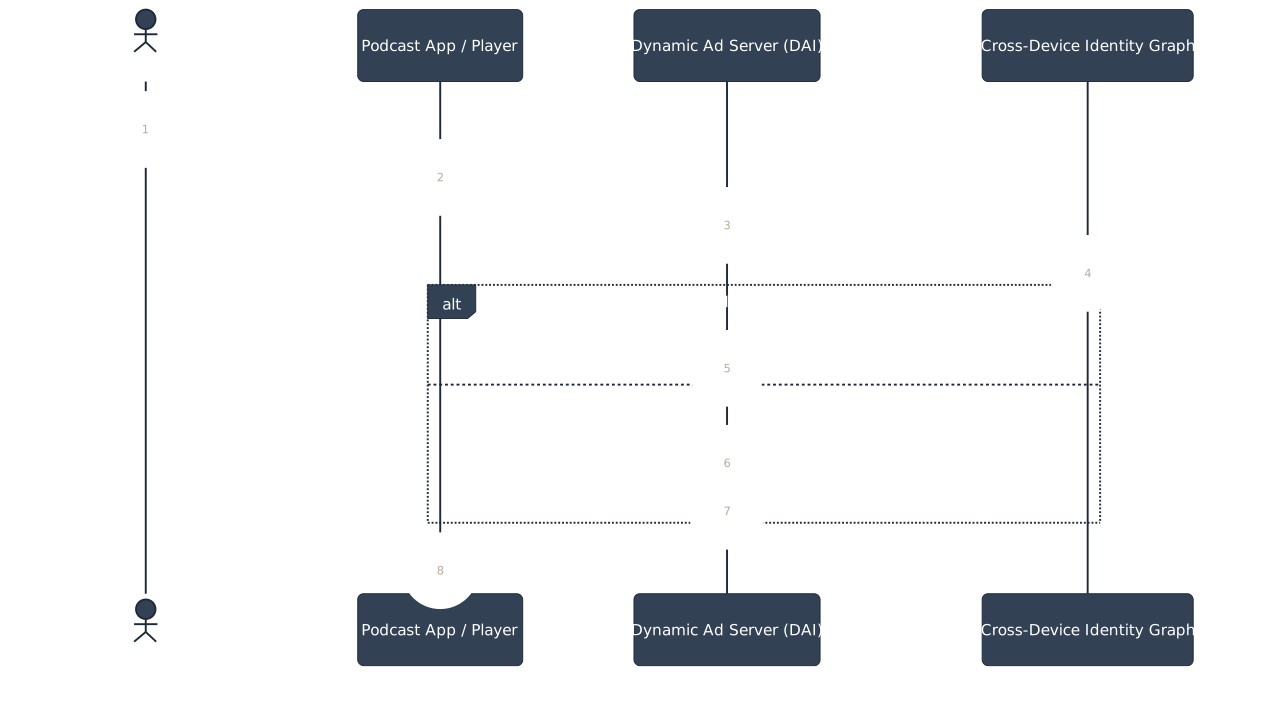
Dynamic Ad Insertion (DAI) allows publishers to swap out promotional audio or video files based on real-time viewer data at the exact moment of download. Advertisers use dynamic insertion to set strict frequency caps, ensuring a specific device only receives the same creative a defined number of times. This targeted approach prevents a single listener from being overwhelmed by identical promotional scripts.
Advertisers use dynamic insertion to set strict frequency caps, ensuring a specific device only receives the same creative a defined number of times.
We can easily integrate our monetization strategies via VAST tags, provided your platform is dynamically compatible and IAB compliant. This standardized Video Ad Serving Template (VAST) protocol lets demand-side platforms (DSPs) count impressions accurately while immediately respecting the media buyer’s maximum exposure limits. When an application requests the media file, the server checks the user profile against active campaigns to select an appropriate, unexhausted promotional spot.
Without a centralized DAI system, a campaign running across multiple independent networks will inevitably serve duplicate ads to overlapping subscribers. Media planners utilize specialized DSPs like The Trade Desk or Google Display & Video 360 to consolidate these frequency parameters across disparate publisher direct buys. This centralization prevents a single listener from hearing the exact same promotional read four times in one afternoon.
Frequency Capping by Platform: YouTube vs. Spotify vs. RSS Feeds

Different distribution channels utilize completely separate ad delivery mechanisms, creating major walled garden attribution gaps for media buyers. YouTube serves video podcast ads through Google Ads, utilizing Google’s proprietary user graph to strictly limit ad frequency across logged-in accounts. A user watching on a desktop browser and then switching to the YouTube mobile application maintains a unified frequency cap.
Spotify Video operates its own closed ecosystem managed entirely through the Spotify Audience Network interface. An ad served on Spotify cannot share a frequency cap parameter with an ad served on YouTube, meaning a cross-platform viewer easily receives duplicate exposures across both applications. Planners must calculate this expected overlap manually when budgeting campaigns across multiple closed environments.
Meanwhile, open RSS feeds distribute MP4 video or MP3 audio files to decentralized applications like Pocket Casts or Overcast. These open protocols rely strictly on IP address mapping and user-agent strings rather than authenticated user logins for impression tracking. A campaign split evenly across these three distinct delivery methods will generate significantly higher duplicate reach than a consolidated buy.

The Difference Between Baked-In and Dynamically Inserted Ads
Baked-in promotions are permanently edited into the primary video podcast file before the creator uploads the episode to their hosting provider. Because these segments are permanently encoded into the core media file, they live forever and cannot adapt to a listener’s historical ad exposure. A viewer watching a three-year-old episode sees the exact same promotional segment as a user who watched it on release day.
If a subscriber watches an older episode featuring a baked-in read for Walmart, they receive that impression regardless of any current programmatic campaign parameters. Consequently, advertisers cannot apply standard frequency capping mechanisms, geographic targeting, or time-bound tracking to baked-in placements. Every single download or stream delivers the identical file, guaranteeing absolute exposure but zero frequency control.
Dynamically inserted ads exist as entirely separate media files stitched into the stream at the millisecond a user presses play. This separation allows servers to reference an external database and decide whether a specific viewer has already seen the spot. For our own partners, we recommend that you pick from pre-roll, mid-roll, host-read, and programmatic ad placements based on your specific measurement capabilities.
Cross-Platform Distribution and Audience Overlap
Modern creators distribute their shows across video hosting sites, audio directories, and short-form social media clips simultaneously to maximize visibility. This omnipresence guarantees that devoted fans will encounter the brand message in multiple formats throughout their weekly media consumption habits. A dedicated viewer might watch the full episode on a Smart TV and later encounter promotional clips on Instagram Reels.
Audience reach overlap between a YouTube channel and an Apple Podcasts feed can be significant for highly engaged niche communities. An industry analysis confirmed that the most effective podcast ad is one people actually hear repeatedly across their preferred listening devices. Repetition builds familiarity, transforming a standard promotional read into a recognized endorsement.
Advertisers who embrace this overlap often see higher brand recall because the repetition reinforces the core value proposition presented by the host. However, this cross-platform duplication requires careful budget allocation across different networks to prevent exhausting the available addressable audience. Buyers adjust their frequency expectations knowing that true cross-platform deduplication remains technically impossible without a universal identity token.
Pixel-Based Attribution and Cross-Device Tracking
Tracking conversions after an ad exposure requires connecting the podcast viewing event to a subsequent website visit or digital purchase. Pixel-based attribution platforms generate unique tracking URLs that publishers embed directly within their episode show notes and video descriptions. When a viewer clicks the link, the tracking pixel captures their device information and maps it against the ad server’s download logs.
This mapping process bridges the gap between a mobile video view and a subsequent desktop browser purchase completed days later. Industry reporting shows that podcast ads deliver significant impact for niche advertisers when attribution pixels correctly resolve these complex cross-device paths. Media buyers rely heavily on these analytical tools, utilizing standard 1×1 image pixels and server-to-server integrations, to justify their return on ad spend metrics.
Despite continuous technological advances, pixel tracking still faces severe limitations regarding cookie deprecation and privacy features like Apple App Tracking Transparency. Advertisers increasingly supplement pixel data with traditional vanity URLs and custom promotional codes to ensure accurate measurement across fragmented audiences. A combination of digital pixels and manual codes provides the most reliable picture of total campaign performance.
Household IP Address Matching and Deduplication Limits
A major limitation of podcast tracking involves the heavy reliance on household IP addresses for basic user identification and frequency capping. When multiple family members watch different video podcasts on the same home Wi-Fi network, ad servers utilizing basic IPv4 protocols often group them as a single consolidated user. This IPv4 sharing causes severe inaccuracies in reporting, as the server mistakenly assumes one person is consuming an impossible volume of media.
Conversely, a single listener switching between home Wi-Fi and cellular data appears as two completely distinct users to the tracking systems. Co-viewing on Connected TV devices adds another layer of complexity to these persistent deduplication limits. If three roommates watch a video podcast together on a Roku device in the living room, the ad server only registers one technical impression despite reaching three individuals.
Industry tracking vendors attempt to resolve these discrepancies by mapping IP addresses against persistent device graphs provided by third-party data brokers. However, the open nature of RSS feed distribution means these complex device graphs are rarely perfectly accurate for long-tail audio listeners. Advertisers must accept a margin of error when reviewing unique reach reports for open-web podcast campaigns.
Managing Ad Fatigue and Repeated Message Exposure
Exposing a viewer to the exact same creative ten times in a single week leads directly to ad fatigue and sharply diminished conversion returns. Savvy media planners combat this overexposure by supplying multiple variations of a script for the host to read during the recording session. Rotating these creative assets allows media buyers to maintain high brand visibility without annoying the core listener base.
Rotating these creative assets allows media buyers to maintain high brand visibility without annoying the core listener base.
Exploring the details of is podcast advertising effective reveals that varied messaging significantly improves sustained response rates over multi-month campaigns. A campaign featuring different value propositions for Monday, Wednesday, and Friday episodes keeps the endorsement feeling fresh and highly relevant. We utilize this rotational strategy extensively for clients like American Express, Airbnb, and McDonald’s to maximize their long-term audience engagement.
Shows like 11 Personnel frequently utilize rotational strategies to ensure their weekly listeners receive fresh promotional content. Active management prevents a high-frequency campaign from damaging the creator’s carefully cultivated relationship with their community.
Programmatic Buying Versus Direct Network Buys
Purchasing inventory directly from a creator network allows for customized integrations, premium positioning, and guaranteed total share of voice. Our network, for instance, sees an $22.35 Avg. 60-Sec CPM, which gives you a benchmark for what quality inventory can command. Direct buys typically execute manually, meaning frequency caps are managed entirely by the individual publisher’s internal ad operations team.
By contrast, programmatic buying automates the entire transaction through demand-side platforms using standardized real-time bidding (RTB) protocols. Programmatic technology excels at enforcing strict global frequency caps across hundreds of independent shows simultaneously. We utilize integrations with supply-side partners like Magnite to ensure our inventory connects securely with these major DSP platforms.
For a comprehensive view of pricing structures, understanding the average podcast ad rates helps buyers decide between direct relationships and programmatic efficiency. Direct buys offer unmatched host authenticity, while programmatic execution provides the rigorous frequency control required by large performance marketing agencies.
Multi-Touch Attribution in Video Podcasting
A viewer rarely makes a purchase immediately after seeing a single pre-roll video ad during a thirty-minute interview segment. Multi-touch attribution models assign partial financial credit to every ad exposure a user encounters before finally converting on the website. If a user watches a sponsored YouTube video, hears an audio mid-roll three days later, and then clicks a retargeting banner, the attribution model maps that complete journey.
This complete approach proves that duplicate reach across different formats often acts as a necessary catalyst for driving consumer action. Implementing multi-touch tracking requires integrating podcast pixel data directly into broader marketing analytics platforms like Google Analytics or Adobe Analytics. This data integration allows growth teams to view video podcast performance perfectly aligned alongside paid search and social media efforts.
Companies reviewing podcast ad placement practices increasingly demand these multi-touch measurement capabilities before committing large quarterly budgets. Proper attribution justifies the higher CPMs associated with premium video inventory by proving the format’s contribution to final closed revenue.
The Impact of Video Ads on Conversion Rates
Adding a visual component to a traditional audio endorsement fundamentally changes how audiences process and remember the promotional message. Viewers can literally see the host physically interacting with a physical product, which builds a much stronger parasocial trust dynamic. Studies regarding the impact of host-read podcast ads confirm that visual demonstrations significantly boost direct response metrics compared to audio alone.
The inclusion of visual promotional codes directly on the video screen eliminates the common friction of remembering a complex URL. When a video podcast ad reaches the same person twice, the second visual exposure often serves as the final prompt needed to trigger a website visit. The combined auditory and visual stimulation creates stronger memory pathways than a standard static banner ad.
Brands using these hybrid formats consistently report higher average order values (AOV) from customers acquired through video podcast channels. The medium attracts a highly engaged audience willing to spend considerable time with long-form content, making them highly valuable prospects.
FAQ
Does dynamic ad insertion prevent listeners from hearing the same ad twice?
Dynamic ad insertion utilizes frequency capping to limit duplicate exposure, but it cannot entirely prevent it across disjointed platforms. If a listener switches devices or consumes the show across both YouTube and a standalone RSS application like Overcast, the ad servers log them as separate users and serve the ad again.
Can advertisers track exact audience overlap between different shows?
Advertisers rely on third-party attribution platforms utilizing IP address mapping and device graphs to estimate audience overlap between distinct programs. These tools provide a statistically significant model of duplicate reach, though absolute precision remains difficult due to shared household Wi-Fi networks and strict privacy restrictions like Apple App Tracking Transparency.
Are baked-in podcast ads subject to frequency caps?
Baked-in ads are permanently encoded into the video or audio MP4 file and cannot be controlled by external frequency capping systems. Anyone who downloads or streams that specific media file receives the ad exactly as recorded, regardless of their past exposure history to that specific campaign.
How do programmatic platforms manage cross-device reach?
Programmatic demand-side platforms like The Trade Desk utilize identity resolution graphs to link smartphones, tablets, and smart TVs back to a single user profile. This allows media buyers to set a global frequency limit for a campaign, ensuring the ad stops serving once the individual reaches the maximum defined views across all their known household devices.
Next Steps for Your Ad Strategy
Understanding how video podcast ads distribute impressions across fragmented audiences allows you to allocate your media budget effectively. Managing duplicate reach requires the right combination of pixel tracking, dynamic insertion technology, and disciplined creative rotation. Since we were EST. 2023, our focus has been connecting brands with highly engaged audiences through measurable, data-backed integrations.
Whether you prefer direct network buys or programmatic executions, having access to accurate reporting is absolutely crucial for long-term growth. To explore how our inventory and tracking solutions can elevate your next campaign, reach out to our team.
About the author
Tariq Basraoui
CEO
Tariq O’Keefe Basraoui, Co-Founder of Big Pond Podcasts, is a seasoned digital marketer and community builder with a track record of success at platforms like TikTok and Zencastr. Known for launching Zencastr’s Creator Network to over 15,000 members in 18 months, his expertise lies in growing user bases and enhancing brand engagement.
His strategic approach to growth and community engagement has established him as a leader in creating some of the fastest-growing media networks in podcasting.
