
Stop wasting time on clunky workflows. The best tools for efficient podcast production and distribution automate tedious tasks, streamline collaboration, and provide clear analytics to grow your audience. This curated list focuses on platforms that integrate well, reduce manual editing, and simplify multi-platform publishing. For those looking to automate production or grow revenue, explore these podcast management tools. By choosing the right software for recording, editing, hosting, and marketing, you can save upwards of 5-10 hours per episode, freeing you to focus on creating great content that connects with listeners.
At Big Pond Podcasts, we work with numerous shows, and we see firsthand which tools actually move the needle. This list is built from that experience. We ranked these tools based on a weighted score considering user reviews on G2 and Capterra, the breadth of their integration capabilities, and specific features that directly reduce production bottlenecks. We prioritized platforms that offer robust free tiers or scalable pricing, making them accessible to creators at all levels.

Recording Software: Capturing Your Audio
High-quality audio is non-negotiable. Your recording software is the first step in the production chain, and a poor choice here will create hours of extra work in post-production. Look for tools that record locally to avoid internet-related dropouts.
1. Riverside.fm
Riverside.fm has become a standard for remote interviews for a reason. It records separate, uncompressed WAV audio and up to 4K video tracks locally for each participant. This means if someone’s internet connection stutters, it doesn’t ruin the recording. Its editor uses transcripts to edit video and audio, which is a massive time-saver. After recording, it automatically uploads all files to the cloud, so you don’t have to chase down participants for their local files.
- Best for: Podcasters who conduct remote interviews and prioritize audio/video quality.
- Watch out for: The free plan limits you to two hours of separate track recording; after that, a subscription is needed.
- A 2023 report noted that poor audio quality is a top reason listeners abandon a podcast, making tools like Riverside essential.
2. Zencastr
Similar to Riverside, Zencastr was one of the first to solve the remote recording problem with local backups. It offers high-definition video recording and high-quality audio, ensuring high fidelity. A key feature is its automated post-production, which can mix your audio tracks and master them to meet loudness standards with a single click. Their new tools for creators help with content repurposing, which is a big part of effective distribution.
- Best for: Creators looking for an all-in-one recording and basic post-production solution.
- Watch out for: The highest quality video and automated mastering are part of their paid plans.
- Zencastr’s platform has helped build massive creator networks, with my own work there growing a community significantly in a relatively short period. This demonstrates the power of a solid recording foundation.
Audio Editing Software: Crafting Your Sound
| Software | Pricing Model | Key Features | Ease of Use | |
|---|---|---|---|---|
| Audacity | Free | Open-source, Multi-track editing | Beginner-friendly | |
| Adobe Audition | Subscription | Professional tools, Noise reduction, Advanced mixing | Intermediate to Advanced | |
| Descript | Subscription (Freemium) | AI-powered, Text-based editing, Transcription | Beginner to Intermediate | |
| GarageBand | Free (macOS/iOS) | Basic editing, Music creation, Sound effects | Beginner |
Editing is often the most time-consuming part of podcasting. The right software can dramatically speed this up. While DAWs (Digital Audio Workstations) are powerful, a new breed of AI-powered and text-based editors are changing the game for spoken-word content.
3. Descript
Descript pioneered transcript-based editing. You edit the audio by simply editing the text document, which feels more like working in Google Docs than a traditional timeline. It can automatically remove filler words (“um,” “uh”), add EQ and compression with its “Studio Sound” feature, and even create a clone of your voice to fix mistakes later. This is one of the most powerful tools for efficient podcast production available.
- Best for: Solo creators and teams who want the fastest possible editing workflow for dialogue-heavy shows.
- Watch out for: Music editing and complex sound design are less intuitive than in a traditional DAW.
- Descript’s Overdub feature can save entire re-recording sessions. Many independent podcasters edit their own shows, making efficiency tools like Descript critical for avoiding burnout.
4. Hindenburg PRO
Hindenburg PRO is a DAW built specifically for radio journalists and podcasters. It lacks the complex music production features of other DAWs, focusing instead on tools for storytelling. It automatically sets loudness levels to broadcast standards, has a clipboard for organizing clips, and features like voice profiling automatically apply EQ settings to different speakers. It simplifies the technical side of audio so you can focus on the narrative.
- Best for: Narrative podcasters and journalists who need powerful storytelling tools without the music-production bloat.
- Watch out for: It has a steeper learning curve than Descript and is a traditional timeline-based editor.
- Hindenburg’s adherence to loudness standards (like -16 LUFS for stereo) ensures a consistent listener experience across platforms, a key mark of professionalism.
The goal isn’t to find one tool that does everything. It’s to build a stack of 3-4 specialized tools that integrate perfectly, automating the handoffs between recording, editing, and distribution.
Hosting and Distribution Platforms: Reaching Your Audience
| Platform | Pricing Model | Analytics | Monetization | Ease of Use | |
|---|---|---|---|---|---|
| Buzzsprout | Tiered (Freemium) | Good | Dynamic ads, Affiliate marketplace | Beginner-friendly | |
| Transistor.fm | Subscription | Advanced, Multiple podcasts | Donations, Paid content | Intermediate | |
| Anchor (Spotify for Podcasters) | Free | Basic | Integrated ads, Listener support | Beginner-friendly | |
| Libsyn | Tiered subscription | Comprehensive | Advertising, Premium content | Intermediate to Advanced |
Your podcast host is where your audio files live. It generates the RSS feed that you submit to directories like Apple Podcasts and Spotify. A good host provides reliable storage, fast downloads, and insightful analytics.
5. Transistor.fm
Transistor.fm is known for its excellent analytics and creator-friendly features. It allows you to host multiple shows on one account at no extra cost, which is great for building a network. Their analytics show you trends, popular episodes, and which apps your listeners are using. They also provide simple, embeddable players and automatically post your episodes to YouTube. If you want to diversify your podcast income, having a clear view of your listener data is the first step.
- Best for: Professional podcasters, networks, and businesses that need top-tier analytics and multi-show support.
- Watch out for: It’s priced higher than some entry-level hosts, reflecting its professional feature set.
- Apple Podcasts still accounts for a significant share of downloads, and Transistor provides deep insights into this crucial platform.
6. Captivate
Captivate positions itself as “the world’s only growth-oriented podcast host.” They back this up with a suite of built-in marketing tools. This includes automatically generated sponsor kits, private podcasting capabilities, and one-click submission to all major directories. Their analytics are IAB Certified, which is the industry standard for providing trustworthy numbers to advertisers. This makes it a great platform if you plan to monetize and grow your podcast.
- Best for: Independent creators focused on audience growth and monetization from day one.
- Watch out for: Some of the more advanced marketing features are only available on higher-tier plans.
- Using an IAB certified host is critical for attracting serious sponsors. We help connect advertisers with podcasters and can attest that verifiable download numbers are a must.
Promotion and Marketing Tools: Growing Your Listener Base

Publishing your episode is only half the battle. You need tools to promote it effectively and turn listeners into subscribers. Automation is key to maintaining a consistent marketing presence without burning out.
7. Headliner
Headliner is the go-to tool for creating audiograms: short videos that combine your audio with a waveform, image, and captions. These are perfect for sharing on social media platforms like Instagram, TikTok, and LinkedIn, where native audio is not supported. It can automatically select clips from your episodes, transcribe them, and generate dozens of video variations for you to choose from.
- Best for: All podcasters who want to promote their show on social media with engaging video clips.
- Watch out for: The free plan includes a watermark, which is removed on paid plans.
- With over 200M+ monthly listeners reachable on our network, we know that getting your show in front of new audiences on different platforms is crucial for growth.
8. Rephonic
Finding other podcasts for cross-promotion is one of the most effective growth strategies. Rephonic is a database that helps you discover podcasts in your niche, providing their contact information, audience demographics, and engagement scores. You can find shows to pitch for guest appearances or arrange audience swaps. It takes the guesswork out of podcast outreach.
- Best for: Podcasters ready to scale their audience through strategic guesting and cross-promotions.
- Watch out for: It’s a specialized, subscription-based tool designed for serious outreach efforts.
- Data from a study on podcast discovery suggests that word-of-mouth and social media are top ways people find new shows, and Rephonic helps you engineer that word-of-mouth.
Monetization Tools: Generating Revenue
Once you have an audience, you need tools to help you generate revenue. This can be through ads, subscriptions, or other models. The right platform simplifies the process of connecting with advertisers and managing payments.
9. Big Pond Podcasts
Our platform at Big Pond Podcasts is designed to connect creators with advertisers for host-read ads and sponsorships. We provide a marketplace where you can list your show and advertisers can discover you. We focus on providing the tools for efficient podcast production and distribution so you can focus on creating. Our network aims to provide a clear path to revenue for our creators.
- Best for: Podcasters looking to monetize with authentic, host-read ads and find brand partnerships.
- Watch out for: We focus on sponsorship and ad opportunities, so it’s best paired with a separate hosting platform.
- We make it easy to find sponsors that align with your content and audience, which is a key part of our mission to amplify diverse voices.
10. Memberful
For podcasters who want to offer premium content, Memberful is a powerful tool. It integrates with your existing website and podcast host to create private, members-only RSS feeds. You can offer ad-free episodes, bonus content, or early access to your paying subscribers. It handles all the payments, subscriptions, and feed management, allowing you to build a direct relationship with your most dedicated fans. This is a crucial element of many modern podcast ad tools.
- Best for: Creators with an engaged community who want to generate recurring revenue through memberships.
- Watch out for: You’ll need a separate website (like WordPress or Squarespace) to integrate it with.
- Memberful was acquired by Patreon, but it remains a distinct product focused on deep integration with your own brand and website.
Don’t get distracted by a tool’s 100 features. Ask what its single, core job is. If that job saves you two hours an episode, it’s worth paying for. If it doesn’t, it’s a distraction.
Summary of Podcast Production and Distribution Tools
| Tool | Category | Key Feature | Price Model |
|---|---|---|---|
| Riverside.fm | Recording | Local WAV/4K recording | Freemium |
| Zencastr | Recording | Automated post-production | Freemium |
| Descript | Editing | Transcript-based editing | Freemium |
| Hindenburg PRO | Editing | Broadcast standards focus | Subscription |
| Transistor.fm | Hosting | Advanced analytics | Subscription |
| Captivate | Hosting | Built-in marketing tools | Subscription |
| Headliner | Promotion | Audiogram creation | Freemium |
| Rephonic | Promotion | Cross-promotion database | Subscription |
| Big Pond Podcasts | Monetization | Ad marketplace | Service-based |
| Memberful | Monetization | Private RSS feeds | Subscription |
Choosing the right tools for efficient podcast production and distribution is an investment in your show’s future. It reduces burnout, improves quality, and accelerates growth. Start by identifying the biggest bottleneck in your current workflow and find a tool that solves that specific problem. From there, you can build a powerful, integrated system that lets you focus on what you do best: creating.
If you’re ready to grow and monetize your show, get in touch with our team to see how we can help.
FAQ
What software do most podcasters use?
There isn’t one single answer, but a common stack includes Riverside.fm for recording, Descript for editing, and a host like Transistor.fm or Captivate. Many also use Hindenburg for more detailed audio work and Headliner for social media promotion.
How can I make my podcast production faster?
The fastest way is to use tools that automate manual work. Use transcript-based editors like Descript to cut down editing time. Use hosts that automate distribution to major platforms. Finally, use templates for your show notes and marketing assets.
Do I need to pay for podcast hosting?
Yes, you should plan on paying for a reliable podcast host. While some platforms offer free hosting, they often come with significant limitations on storage, bandwidth, or analytics.
What are the essential tools for a beginner podcaster?
A beginner should start with three things. A good USB microphone, a remote recording tool like Zencastr or Riverside (even their free plans), and a podcast host like Captivate. This covers capture, editing basics, and distribution.
How do I distribute my podcast to Spotify and Apple Podcasts?
Your podcast hosting platform handles this. After you upload your audio file and episode details to your host, they will provide you with an RSS feed. You will then submit this RSS feed once to each directory (Apple Podcasts, Spotify, etc.). After that, every new episode you publish will be sent to them automatically.
What’s the difference between a DAW and an editor like Descript?
A Digital Audio Workstation (DAW) like Hindenburg or Audition is a timeline-based tool designed for detailed audio manipulation, including music and sound design. An editor like Descript is text-based, meaning you edit the audio by editing the transcript. Descript is much faster for spoken-word content, while a DAW offers more granular control. Learning about the different options is part of a good podcast production management strategy.
About the author
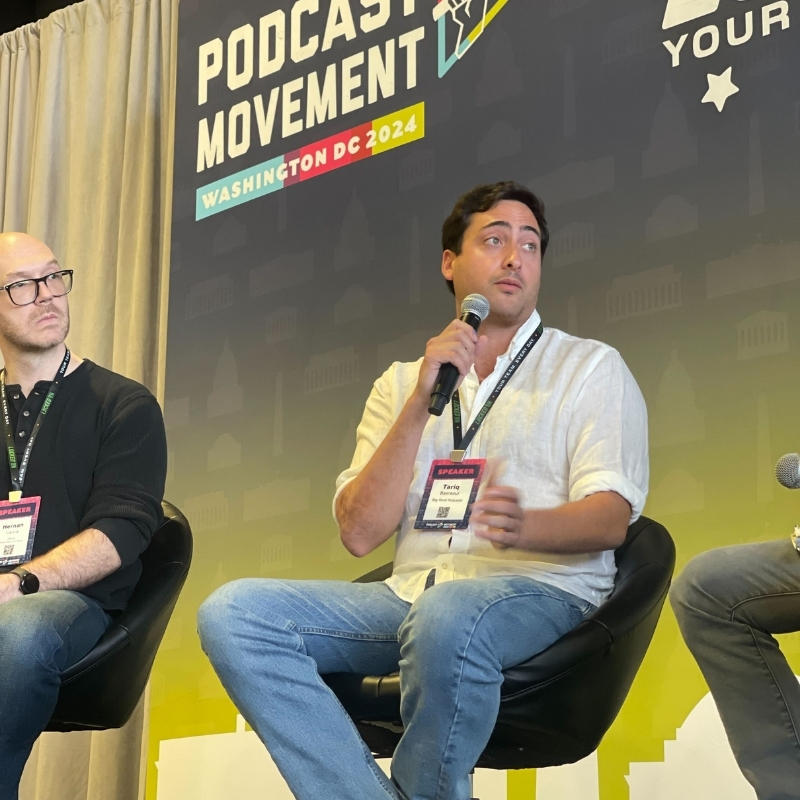
Tariq Basraoui
CEO
Tariq O’Keefe Basraoui, Co-Founder of Big Pond Podcasts, is a seasoned digital marketer and community builder with a track record of success at platforms like TikTok and Zencastr. Known for launching Zencastr’s Creator Network, his expertise lies in growing user bases and enhancing brand engagement.
His strategic approach to growth and community engagement has established him as a leader in creating some of the fastest-growing media networks in podcasting.
